 Menu






AI security for a braver tomorrow
Human Ambition Deserves a Stronger Guardian.
AI Deployment AssuranceSee what AI can access. Test what it can do. Maintain the evidence behind every decision.
AI can expand what people create, discover and deliver. Mythos AI Security helps organizations move forward with evidence about access, authority, behavior, business consequence and change — so bold AI initiatives rest on stronger decisions.


The challenge
AI Opens Extraordinary Possibilities. And Extraordinary Risks.
Organizations are moving faster than traditional testing and governance can follow. The risk is not only what an AI model says — it is what it can reach, decide and do.
Reach
What can it reach?
Data, tools, identities and systems an AI can touch — including the ones nobody declared.
Authority
What is it allowed to do?
Who granted the authority, and whether each action still matches it.
Effect
What actually happened?
The difference between what an agent says and what it changes.
Proof
What still holds?
Evidence that stays meaningful as models, tools and permissions change.
The path
From Risk to Resilience.
Discover the surface. Understand authority. Protect critical workflows. Respond with evidence. Strengthen continuously.






Stage 1 of 5 · Discover
Discover the surface.
Map the AI systems in scope — models, routes, identities, tools and data — including what nobody declared.
- Evidence produced
- System and authority map
- Led by
- Athena
The journey is the story. Beneath it runs the technical assurance cycle that governs every report.See the cycle
Beneath the journey
Assurance Is a Cycle, Not a Checkbox.
Discover → Understand → Test → Prove → Revalidate is the operational proof workflow beneath every stage of the broader resilience journey.
- 01
Discover
Map what exists — AI systems, routes, identities, data and the tools they can reach.
- Produces
- System map and coverage
- Led by
- Athena
- Serves
- Discover
- 02
Understand
Establish what each system is authorized to do, and what evidence supports it.
- Produces
- Authority chain
- Led by
- Athena · SPINE
- Serves
- Understand
- 03
Test
Challenge behavior and authority: can the AI cause an effect it was not authorized to cause?
- Produces
- Observed findings
- Led by
- Achilles
- Serves
- Protect
- 04
Prove
Turn results into claims, receipts and a deployment decision a human can verify.
- Produces
- Claims, receipts, decision
- Led by
- SPINE
- Serves
- Respond
- 05
Revalidate
When the system changes, retest what the change invalidated — and keep the evidence current.
- Produces
- Revalidated evidence
- Led by
- SPINE
- Serves
- Strengthen





Revalidate feeds the next Discover: when the system changes, the cycle runs again on what changed.

The Mythos AI Security product family
Specialized Capabilities. One Connected Platform.

 AthenaSee the system.Map access, exposure, relationships, policies and proof.Explore Athena

 SPINEMaintain the truth.Link claims to evidence, authority, changes and decisions.Explore SPINE

 AchillesTest the AI.Challenge behavior, permission boundaries, tool use and approval gates.Explore Achilles

 Internal proving groundMinotaurTest Mythos.Challenge validity, false blocks, regressions and release quality.Explore Minotaur

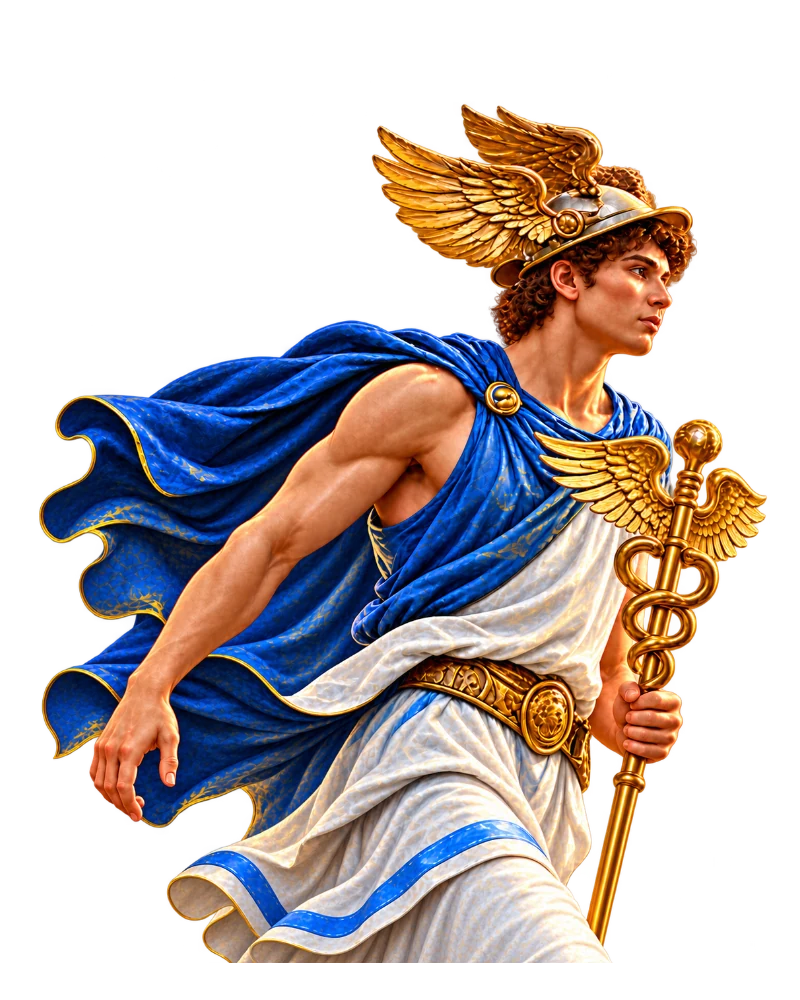 Physical AI horizonHermesAssure physical AI.Extend evidence-based methods toward autonomy and operational systems.Explore Hermes
SPINE
A Passing Test Has an Expiration Date.
Synthetic example · one claim, one change
01 · Change
None pending
Steady02 · Evidence
Retest R-14 against tool manifest v7
Verified03 · Claim
Refunds go only to the original payment method.
Verified04 · Decision
Ready, with restrictions
Ready
 Verified
The claim is verified: a retest against the current tool manifest supports it, and the deployment decision rests on that evidence.

Red · Blue · Purple · Evaluator
Stronger Together, Tested From Every Angle.

Red Team · Adversarial challenge
Authorized adversarial testing of an agreed objective and its technical paths.
Delivers
Reproducible failure evidence, attempted paths and observed effects.
Boundary
Never reads the answer key; cannot expand scope or waive a stop.
Business consequence
A Technical Finding Should Lead to a Better Decision.
- Validated failure
- Loss pathway
- Modeled range
- Remediation scenario
- Human decision
- P10
- $0.6M
- P50
- $2.1M
- P90
- $7.4M
Expected annual exposure
- Today$3.2M
- After the proposed fix$0.9M
A $0.4M fix that removes about $2.3M of modeled annual exposure — with the assumptions, sources and confidence shown beside every figure.
Explore Economic ExposureIllustrative scenario — synthetic data. Economic Exposure prices a validated failure as a range, with its assumptions and sources — never an exact loss or a guaranteed ROI. The customer keeps every business and materiality decision.
Built for what matters
Evidence for AI Across the Environments That Matter.
 Financial Services & InsuranceServicing copilots, customer data and AI suppliers.
 Healthcare & Life SciencesSensitive records, research data and AI-assisted operations.
 AI-Heavy SaaSTenant boundaries, agents and customer security reviews.
 Regulated EnterpriseCopilots, decision support and internal workflows.
 Public Sector & MissionAcceptance and change evidence for mission workflows.
 Manufacturing & Critical InfrastructureOperational AI, vendors and authority — tested outside production.
Building or integrating AI for others? Systems integrators and AI vendors
Buyer proof
Inspect the Evidence, Not Just the Claim.
- Mythos AI SecuritySynthetic
01 · Scope and authorization
What the review may touch
- System
- Customer support agent
- In scope
- Refund tool, CRM read, ticket history
- Excluded
- Production payments ledger
- Authorized by
- Head of Support Ops
- Mythos AI SecuritySynthetic
02 · Finding SR-03
Refund issued above the approval threshold
- Observed effect
- Refund executed without approval
- Evidence
- Trace T-0412, ledger diff
- Basis
- Reproduced twice · benign control
- Next step
- Fix, then retest
- Mythos AI SecuritySynthetic
03 · Claim matrix
What still holds
- Refunds bound to approval
- Contradicted
- Refunds to original card only
- Verified
- CRM read is least-privilege
- Unknown
- Escalation reaches a human
- Stale
How engagement starts
Start With One System. Expand Assurance as Your Estate Grows.
- 1
Define the AI system
Select the AI workflow, assistant, agent, model, copilot, integration, or vehicle/strategic-horizon scenario that needs review.
- 2
Lock the scope
Confirm what systems, data sources, users, tools, environments, and limits are included before testing begins.
- 3
Run the assessment
Mythos AI Security maps exposure, tests behavior, reviews controls, identifies weaknesses, and gathers evidence under the approved scope.
- 4
Review the decision
The customer receives findings, remediation guidance, retest requirements, and a deployment recommendation.
Mythos AI Security testing should be authorized, scoped, non-destructive, and controlled by the customer. Mythos AI Security supplies the evidence; your team keeps every decision.
Request an Assessment

Tested Today. Trusted Tomorrow.
The goal is not to slow human ambition. It is to give teams better proof before they trust AI with meaningful actions.